
Automobile Course After 12th: Career Scope, Salary, Placements & Future Opportunities
- 5 days ago
- 3 min read
Choosing the right career after Class 12 is one of the most important decisions in a student's life. While many students consider traditional engineering or graduation programs, industries today are looking for professionals who possess practical skills and industry experience.
If you are passionate about cars, bikes, electric vehicles, or modern automotive technology, enrolling in an Automobile Course After 12th can open the doors to exciting career opportunities.
With India's automobile industry rapidly evolving towards electric mobility, automation, and smart manufacturing, skilled professionals are in greater demand than ever before
Why Choose an Automobile Course After 12th?
The automobile sector is no longer limited to repairing vehicles. Today's industry focuses on:
Electric Vehicles (EV)
Hybrid Technology
Automotive Electronics
AI-powered Vehicles
Vehicle Diagnostics
Smart Manufacturing
Automation
Service Management
This creates thousands of career opportunities for students with practical knowledge.
Instead of only learning theory, a modern Automobile Technology Course focuses on real-world training that prepares students for the workplace from day one.

What Will You Learn in an Automobile Technology Course?
A good automobile program combines classroom learning with practical workshops.
Students typically learn:
Automobile Engine Technology
Vehicle Maintenance
Automobile Servicing
Transmission Systems
Suspension & Steering
Vehicle Electrical Systems
Auto Electrician Skills
Automotive Electronics
Electric Vehicle Technology
Workshop Safety
Engine Diagnostics
Customer Service Skills
Most importantly, students spend significant time working on actual vehicles and equipment rather than only studying textbooks.
Career Scope After an Automobile Course
The Indian automobile industry continues to grow with increasing investments in manufacturing, electric vehicles, and mobility solutions.
After completing an Automobile Course, students can explore careers as:
Automobile Service Technician
Vehicle Diagnostic Technician
Automobile Service Advisor
Workshop Supervisor
Automobile Production Executive
Quality Inspector
EV Technician
Auto Electrician
Automotive Sales Executive
Service Engineer
Automobile Trainer
Fleet Maintenance Executive
Students can also pursue entrepreneurship by opening their own garage, service center, or automobile workshop.
Salary After an Automobile Course
One of the most common questions students ask is:
"What salary can I expect after an Automobile Course After 12th?"
The answer depends on your skills, internship experience, company, and location.
Typical salary ranges in India are:
Experience | Expected Salary |
Fresher | ₹2.5 – ₹4.5 LPA |
2–4 Years | ₹4 – ₹7 LPA |
Experienced Professionals | ₹7 – ₹12+ LPA |
Professionals with expertise in Electric Vehicles, diagnostics, and advanced servicing often earn higher salaries due to increasing demand.
Why Practical Skills Matter More Than Marks
Today's employers prefer candidates who can perform the job from the first day.
That is why practical learning has become more valuable than theoretical knowledge alone.
A quality Automobile Training program should include:
Practical Workshops
Live Vehicle Servicing
Industry Projects
Hands-on Lab Sessions
Industrial Visits
Expert Faculty
Internship Opportunities
Practical exposure builds confidence and improves employability.
Internship: The First Step Towards Your Career
One of the biggest advantages of skill-based education is industry exposure.
Students who complete internships gain:
Real workplace experience
Industry knowledge
Professional communication skills
Technical confidence
Better placement opportunities
Many companies also provide stipends during internships, allowing students to gain experience while earning.
Placement Opportunities After an Automobile Course
A strong placement support system can significantly improve career prospects.
Students trained in practical skills can find opportunities in:
Automobile Manufacturers
Authorized Service Centers
EV Companies
Automotive Component Manufacturers
Commercial Vehicle Companies
Automobile Dealerships
Fleet Management Companies
Industrial Manufacturing Units
Companies prefer candidates who are already familiar with workshop practices and industry tools.
Automobile Engineering vs Automobile Technology Course
Many students confuse an Automobile Engineer Course with an Automobile Technology Course.
Here's a simple comparison:
Automobile Engineering | Automobile Technology |
More theory-oriented | More practical-oriented |
Focus on design and engineering concepts | Focus on servicing, diagnostics, maintenance, and industry skills |
Ideal for engineering aspirants | Ideal for students seeking faster industry readiness and employability |
If your goal is to become job-ready with practical expertise, an Automobile Technology Course can be an excellent choice.
Future Opportunities in the Automobile Industry
The future of the automobile sector is driven by innovation.
Emerging fields include:
Electric Vehicles (EV)
Autonomous Vehicles
Vehicle Connectivity
Smart Manufacturing
Automotive AI
Green Mobility
Battery Technology
Charging Infrastructure
As these technologies continue to grow, skilled automobile professionals will remain in high demand.
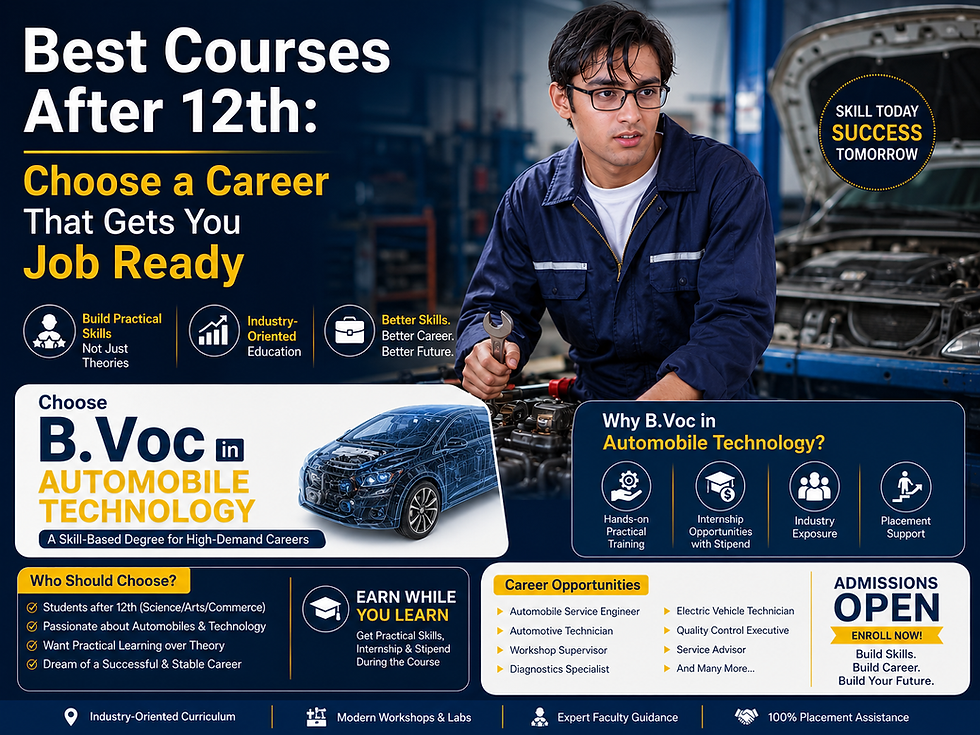
Why Choose B.Voc in Automobile Technology?
If you're looking for a program that combines academics with practical skills, B.Voc in Automobile Technology offers a strong foundation.
Key benefits include:
Industry-Oriented Curriculum
Hands-on Practical Training
Internship Opportunities
Stipend During Internship (where applicable)
Experienced Faculty
Modern Workshops
Placement Support
Skill-Based Learning
Industry Exposure
This approach helps students graduate with both a recognized degree and job-ready skills.
Conclusion
If you enjoy working with automobiles and want a career that combines technology, practical learning, and strong employment opportunities, pursuing an Automobile Course After 12th can be a smart decision.
The key is to choose a program that goes beyond classroom learning and emphasizes practical training, internships, and industry exposure. These experiences can help you build the skills employers value and prepare you for a successful career in the rapidly evolving automobile industry.
Comments